
"3x2" Leadership Framework
The ABC of Interpersonal Leadership
Leadership should provide guidance, enable results, strengthen engagement, and foster development. What is needed to achieve this depends on people, teams, tasks, and working conditions.
“3×2” creates a common roadmap for this. The model organizes key leadership tasks and practices and helps to align leadership appropriately with the respective situation.
This involves interpersonal leadership, meaning the direct management of employees and teams. The focus is on the relationships and interactions through which leadership influences engagement, performance, and development.
The “3×2” model does not prescribe a specific leadership style. It can be applied to different leadership environments and adapted to the situation.
Thus, »3×2« brings together different scientific leadership perspectives in an integrative and holistic framework.
Sorting leadership questions using the "3x2" method
Bring a specific leadership question with you. In an informal conversation, we’ll work together to clarify what’s currently on your mind and outline which perspectives from “3×2” might be particularly relevant.
This will give you an initial overview of which questions you should examine more closely and where you can continue your work.What leadership is needed for
“3×2” does not begin with a specific leadership style, but with the purpose of leadership.
Employees and teams contribute to an organization’s success in various ways. They should achieve results, go above and beyond what is immediately required, and be able to learn and grow with new demands.
“3×2” therefore distinguishes three fundamental areas of impact and links them to the leadership tasks of retention, control and development.
GET
People support others, contribute their time and effort, and take on responsibility beyond their formal roles.
Leadership strengthens this bond, sense of belonging, and willingness to commit to the team and the organization.
CREATE
People achieve agreed goals and reliably implement projects.
Leadership provides orientation, supports implementation, and ensures clarity about goals and expectations.
DEVELOP
People learn, expand their skills, and adapt their actions to new requirements.
Leadership supports development, learning, and adaptability.
What's behind the "2"
Leadership also means shaping relationships. Different expectations collide within these relationships.
Organizations need performance, accountability, and development. Employees, at the same time, need conditions that allow them to meet these expectations.
The “2” in “3×2” therefore stands for two perspectives of every leadership task: demanding and supporting.
DEMAND
Leadership formulates expectations, creates commitment, and aligns actions with common goals and requirements.
PROMOTE
Leadership provides support, creates suitable framework conditions, and helps people to effectively perform their tasks and develop further.
Effective leadership connects both sides. Those who expect responsibility must also consider, for example, what resources, support, or skills are required.
“3×2” thus addresses the give and take in leadership relationships and categorizes leadership practices according to how they reconcile organizational requirements with the concerns of employees.
Six leadership practices provide guidance
Six leadership practices emerge from three leadership tasks and two perspectives.
They do not constitute a fixed process or a recipe for good leadership. They create a common language that enables leaders to assess their situation and consciously shape their leadership behavior.
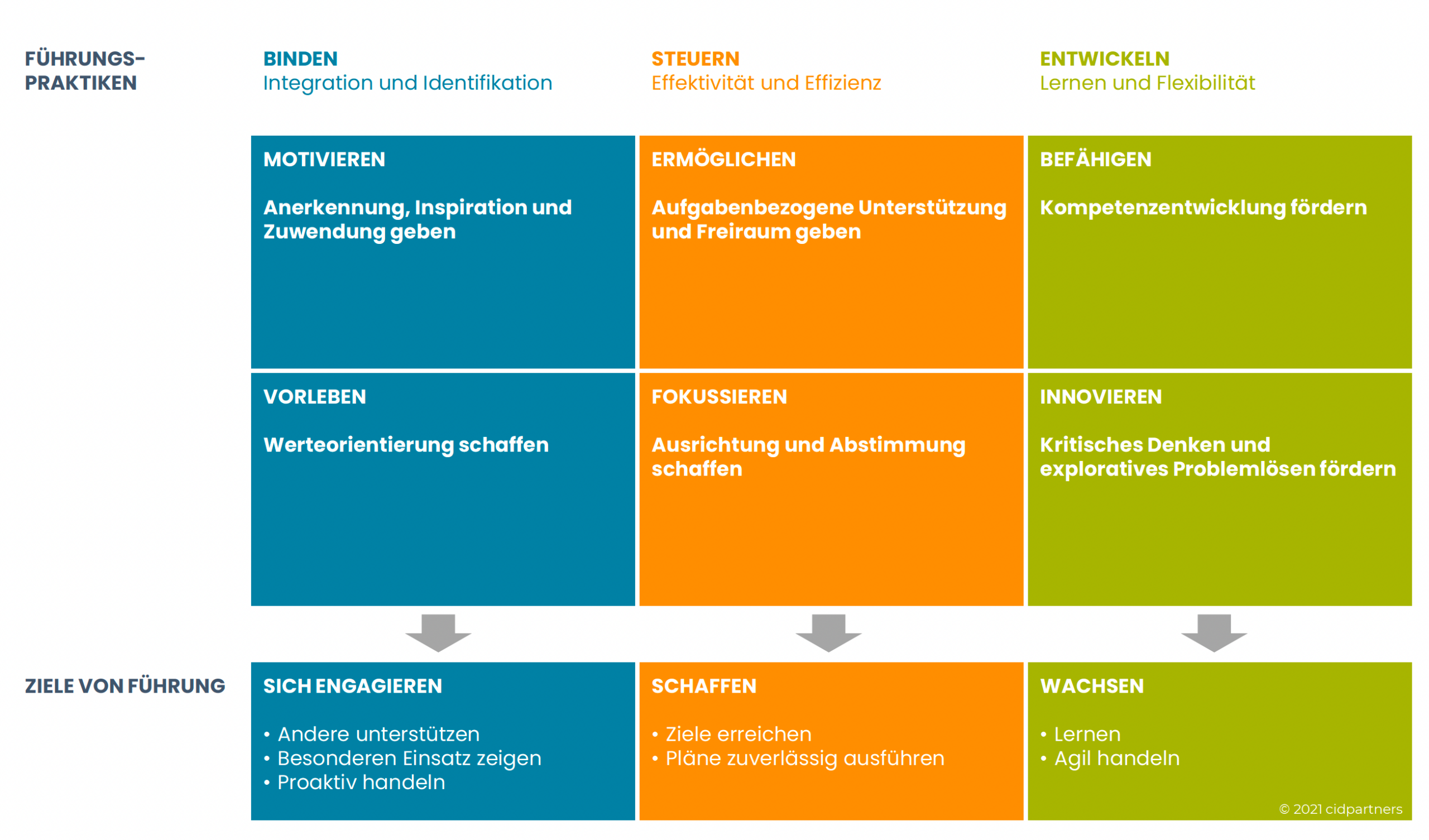
The complete model describes specific behaviors and applications for each of these practices. You can find this level of detail in our whitepaper .
Leadership cannot be reduced to a single style.
Transformational leadership, servant leadership, empowering leadership or agile leadership each have different focuses.
“3×2” doesn’t simply add another leadership style to this landscape. The model organizes different leadership perspectives and practices within a common framework.
“3×2” combines three levels:
WHAT is leadership needed FOR?
What concrete steps can managers take?
HOW should leadership practices interact in a given situation?
Thus, a leadership style should not be understood as a rigid personal pattern, but rather as a situational combination of different leadership practices. The existing cidpartners representation also describes “3×2” as an integrative and situationally adaptable model.
What kind of leadership does the situation require?
Not every leadership situation requires the same combination of the six practices.
Work environments differ in how clear goals and procedures are, how quickly requirements change, and how much knowledge is available about how to achieve a desired result.
“3×2” helps to classify these differences and to weight leadership practices accordingly.
When goals and procedures are largely clear
In more stable work environments, it is often well known how a desired result can be achieved.
Leadership can focus more strongly on shared direction, clear expectations, and reliable implementation. Relationships, motivation, and development remain relevant, but don’t need to be the primary focus in every situation.
when requirements become more complex and dynamic
Where established procedures are no longer reliably sufficient, employees and teams must make more independent decisions, learn and adapt their approach.
Leadership then requires not only guidance but also more enabling, empowering, and space for independent problem-solving.
when new solutions have to be developed
For novel tasks, the right approach is often not yet known.
Leadership can then create conditions under which critical thinking, experimentation and learning become possible without losing the common direction.
when different leadership styles coexist
Very different conditions can prevail within the same organization.
One area operates with established processes, while another has to develop new solutions under high uncertainty. “3×2” offers the same roadmap for both situations, without deriving the same guidance from it.
Our whitepaper describes this situational logic based on different degrees of complexity, dynamics, and process knowledge.
"3x2" as the basis for leadership at cidpartners
For us, “3×2” is not just a model for describing leadership. It forms a common frame of reference for various aspects of our leadership work.
Shaping leadership development
With “3×2”, development areas can be structured and training, coaching or more comprehensive development programs can be designed along a common leadership logic.
The six practices do not constitute a standard curriculum. Depending on the initial situation, different aspects may be the focus.
about reflecting on leadership
“3×2” creates a framework that allows managers to systematically examine their own behavior, strengths, and areas for development.
The “3×2” Leadership Self-Assessment is one of the tools available for this purpose. It helps users reflect on their own leadership practices and derive personal development goals.
delve deeper into specific leadership issues
Based on the “3×2” model, certain requirements for leadership can be examined in more detail.
In the Align-Empower model of agile leadership, the same six leadership practices are classified, for example, according to how they support alignment and empowerment under high agility requirements.
Deepening Leadership
- The "Align - Empower" Model of Agile Leadership
»3x2« Leadership Self-Assessment
»3x2« in the cidPodcast
Leadership topics at a glance




Frequently Asked Questions
What is "3x2"?
“3×2” is an integrative guiding model for the interpersonal leadership of employees and teams.
It combines three basic leadership tasks with two perspectives on leadership and derives six leadership practices from this.
The model helps to view leadership holistically and to prioritize different practices depending on the situation.
What does "3x2" stand for?
The 3 stands for the three leadership tasks of retention, control, and development.
The number 2 represents two perspectives on these tasks: challenging and supporting.
This results in six leadership practices: Motivating, Leading by Example, Enabling, Focusing, Empowering, and Innovating.
What is interpersonal leadership?
Interpersonal leadership refers to the direct management of employees and teams.
The focus is on the relationships and interactions through which leaders influence engagement, performance, learning, and development.
Strategy development, corporate management or structural organizational decisions are therefore not the actual subject of »3×2«.
What do "challenging and supporting" mean in "3x2"?
“Demanding” focuses on what the organization and its tasks require of employees and teams.
Promoting considers what support, framework conditions and development people need to be able to meet these requirements.
Effective leadership combines both perspectives.
Is "3x2" a leadership style?
No.
“3×2” does not prescribe a specific leadership style. It provides a repertoire of six leadership practices that can be combined and weighted differently depending on the situation.
Within this model, a leadership style can therefore be understood as a situational combination of these practices. The current cidpartners representation describes precisely this flexible and situational logic.
Is "3x2" compatible with different leadership styles?
Yes.
The model was designed to be integrative precisely because different leadership concepts emphasize different aspects of leadership.
“3×2” provides a common frame of reference with which these approaches can be classified and combined depending on the leadership requirements.
What does situational leadership mean in "3x2"?
Situational means that the specific combination of leadership practices depends on the context.
Stable tasks with known procedures place different demands on leadership than dynamic, complex situations in which solutions first need to be developed.
The “3×2” framework remains the same. What changes is the weighting of leadership practices.
Must a leader always use all six leadership practices?
Not to the same extent in every situation.
The six practices form a repertoire. Which of them are particularly important depends on the task, employees, team, and work environment.
This situational adaptability is one of the central characteristics of »3×2«.
How can "3x2" be used in leadership development?
“3×2” can be used to structure development needs, build a shared understanding of leadership, and select content for training, coaching, feedback, or more comprehensive leadership programs.
The guidebook explicitly mentions the design of development programs as well as criteria for leadership feedback and assessment as areas of application.
What distinguishes "3x2" from Agile Leadership?
“3×2” is the overarching guiding model for interpersonal leadership.
Agile leadership draws on the same six leadership practices, but asks a more specific question: How can alignment and empowerment be combined under high agility requirements?
The Align Empower model is therefore a specific application of the broader “3×2” framework.
Is there a "3x2" self-assessment?
Yes.
The “3×2” Leadership Self-Assessment helps managers to reflect on their own leadership practice and to identify personal areas for development.