
Startseite » Approach » methods and instruments » Organizational Analysis, & Organizational Design: Spotting Misfits
Spotting Misfits
Spotting Misfits is our holistic approach to organizational analysis and design. The method helps to reveal inconsistencies in the interplay of key organizational components.
The central question is whether environment, strategy, structures, processes, systems, leadership, and culture work together harmoniously. If these elements don’t align, misfits arise. These are inconsistencies that can impair an organization’s performance, collaboration, adaptability, or implementation capacity.
Spotting Misfits is particularly suitable when organizations are growing, strategically realigning themselves, showing efficiency problems, or when existing structures no longer fit the requirements of the environment.

Initial guidance for your organizational question
When problems can no longer be clearly attributed to specific roles, processes, or structures, a joint review is worthwhile. In a no-obligation 30-minute consultation, we’ll assess your current situation and determine the most sensible next step for addressing the issue.
Spotting Misfits at a glance
Brief profile
Applications: Organizational analysis, organizational design, transformation, reorganization, strategy implementation
Participants: Management, department heads, HR, organizational development, transformation managers, selected executives
Materials: Whitepaper, organizational design map, 12 design fields, fit assessment, discussion and analysis questions
Result: Overview of key design areas, identifiable misfits, prioritized areas for action, and a better basis for organizational design decisions.
The purpose of Spotting Misfits
Spotting Misfits helps to view organizational design as an interconnected system. The central question is whether strategy, environment, division of labor, integration, and people & culture are compatible or mutually reinforcing.
This approach refers to such inconsistencies as misfits. They can arise when individual design decisions are plausible on their own, but create friction when combined. Spotting Misfits provides a common map for these issues, shifting the focus from individual symptoms to the interrelationships within the organization.
What the Spotting Misfits tool is helpful for
Some organizational problems initially appear clear-cut: decisions take too long, interfaces function poorly, or a new structure generates more coordination than expected. Often, however, the root cause lies not in a single area.
Spotting Misfits helps
- to reveal connections between different areas of organization,
- distinguish symptoms from potential structural causes,
- systematically identify contradictions in organizational design,
- examine change proposals for potential side effects, and
- prioritize relevant areas for action for further organizational development.
The particular benefit lies in the panoramic view of the organization. This allows for a better assessment of where change is truly needed and which interventions elsewhere might create new tensions. The cidpartners white paper describes precisely this holistic perspective as the core of the approach.
When Spotting Misfits is suitable
Spotting Misfits is particularly suitable when multiple parts of the organizational design are affected simultaneously or when local improvements are not having the desired effect.
Typical situations include:
- a strategic realignment that places new demands on structure and collaboration;
- growth that overwhelms existing roles, processes, or decision-making paths;
- declining efficiency, speed, or quality without a clearly identifiable single cause;
- the introduction of matrix structures, agile frameworks, or new control logics
- reorganizations whose impact on other areas of design needs to be examined
- and situations in which individual changes have already been implemented, but the organization as a whole is not yet functioning coherently.
Spotting Misfits can also be used to test concrete ideas for a new organizational structure: What consequences would the change have for other areas of the organization? Where might new misfits arise? The white paper identifies precisely this examination of existing problems and future design ideas as key applications.
When Spotting Misfits is less suitable
Spotting Misfits is a holistic approach to organizational design. For narrowly defined, specialized issues, more suitable tools are often available.
This applies, for example, when:
- only a single process needs to be analyzed in detail;
- the focus is on job evaluation or clarifying employment roles;
- an acute conflict between individuals or teams needs to be resolved; it
- is already clearly defined what needs to be changed, and only the implementation needs to be planned; or
- a detailed technical analysis is required in a clearly defined area.
Even if one is simply seeking confirmation of a decision already made, spotting misfits is of little help. The approach thrives on actually examining connections and potential contradictions.
Can you use Spotting Misfits yourself?
Yes. Spotting Misfits is well-suited for an initial, structured reflection on your own organization. The map of areas for improvement helps you broaden your perspective and develop initial hypotheses: Where might strategy, structure, governance, leadership, or culture not align well?
However, the perspective of a single individual is often insufficient for a more robust assessment. People from different roles and departments experience the same organization differently. These very differences can provide important clues to misfits.
Therefore, external support can be beneficial for major reorganizations, strategic shifts, or complex matrix and network structures. Neutral facilitation helps to bring together different viewpoints, test assumptions, and prioritize areas for action without prematurely settling for the first explanation that comes to mind.
This is how Spotting Misfits works
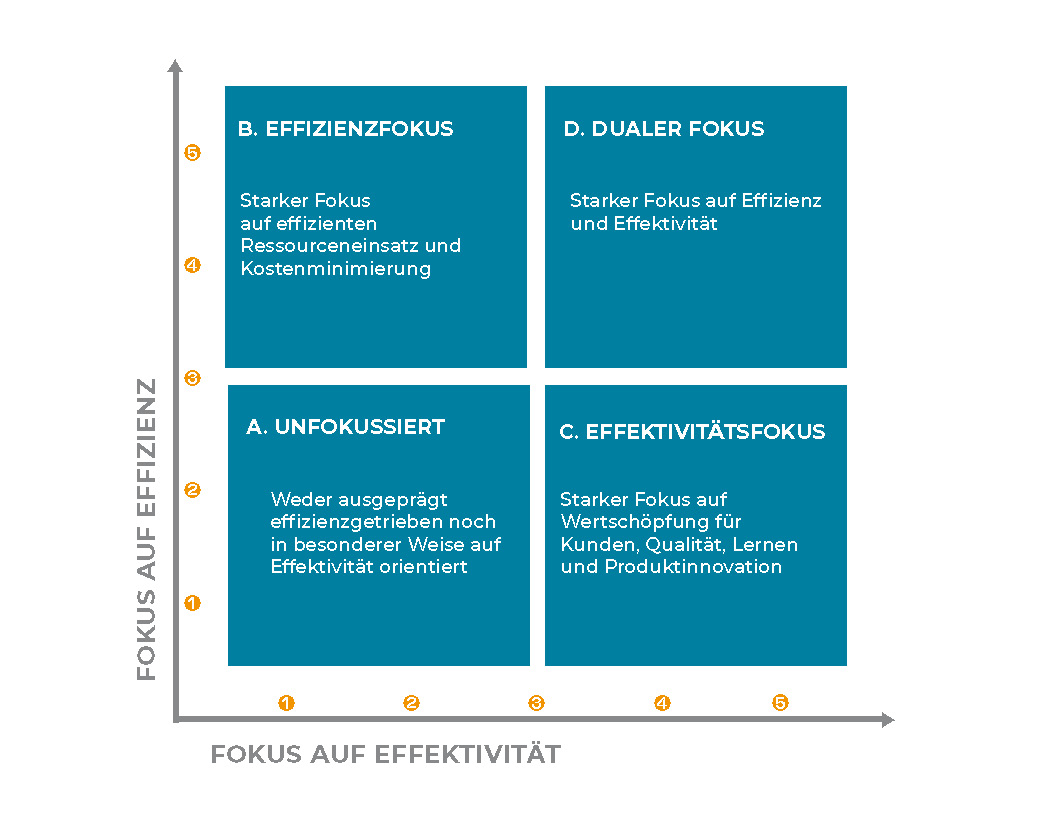
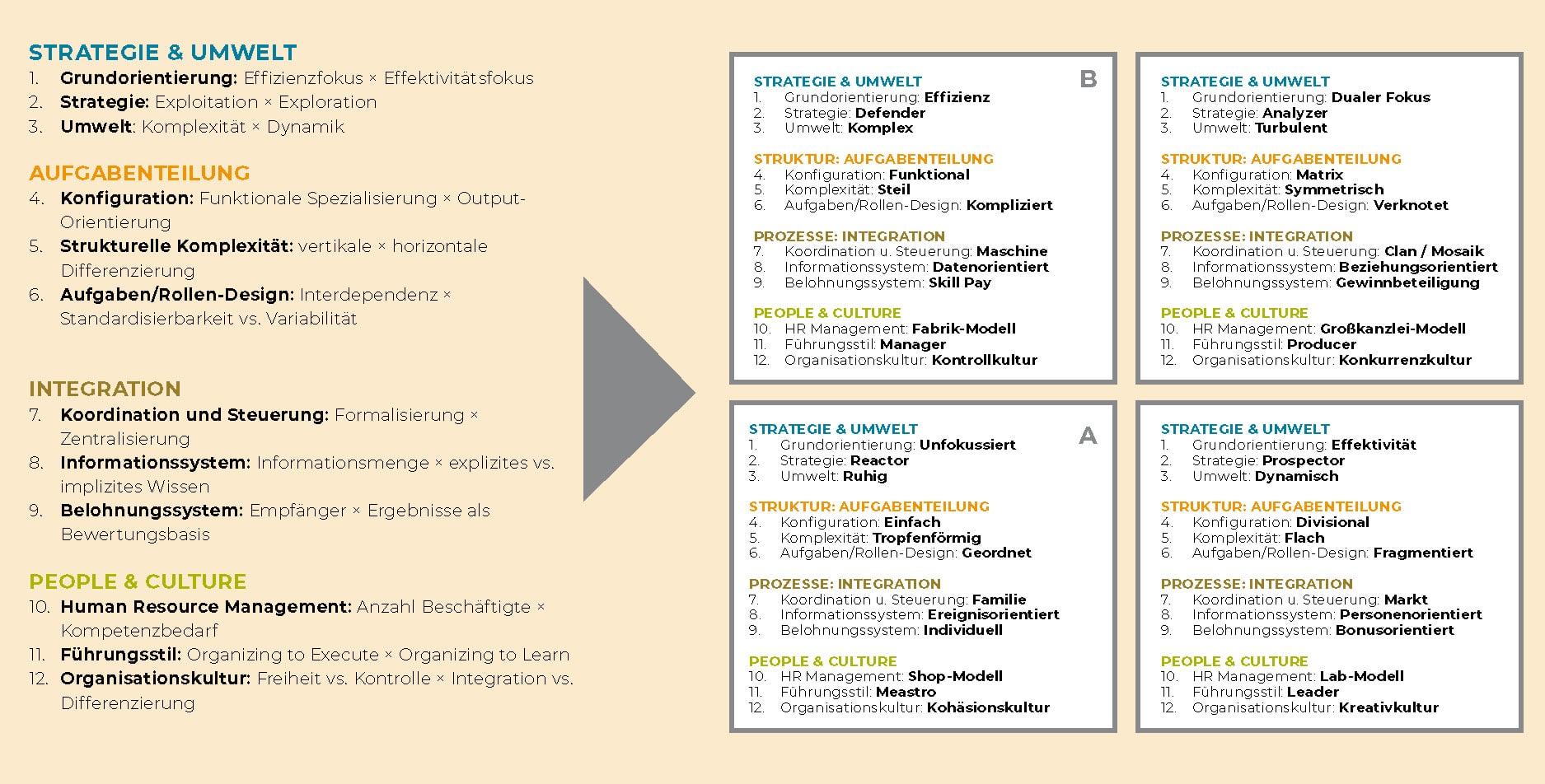
Spotting Misfits works with four clusters and twelve design fields. Each design field is described based on key dimensions. This results in a profile that shows where elements of the organizational design fit together and where misfits arise.
Step 1: Examine strategy and environment
The first step clarifies which requirements from strategy and environment affect the organizational design.
Strategy defines the framework for structures, processes, and systems. Environment describes the complexity and dynamics the organization must manage. When strategy and environment function differently than the existing organizational design, tensions arise.
Guiding questions:
- What strategic direction should the organization actually support?
- What demands does the operational context place on speed, complexity, and adaptability?
Step 2: Analyze the division of labor
The second step considers how work is distributed. This addresses the question: Who does what?
This includes configuration, structural complexity, and task and role design. The relevant factor is whether organizational units, roles, and tasks are structured in such a way that work can be done effectively.
Guiding questions:
- Does the existing structure fit products, customers, markets, projects and professional requirements?
- Are tasks, roles, and responsibilities structured in such a way that coordination remains manageable?
Step 3: Evaluate integration
The third step examines how activities are coordinated and aligned towards common goals.
This includes coordination and control, information systems, and reward systems. Here it becomes clear whether decisions, information, and incentives support or hinder the desired collaboration.
Key questions:
- How are decisions controlled, and where do unnecessary dependencies arise?
- Do information and reward systems support the behavior that is strategically needed?
Step 4: Involve People & Culture
The fourth step considers HR, leadership, and organizational culture.
People & Culture reveals whether competency requirements, leadership style, and cultural assumptions align with the organizational design. An organization can be structurally geared towards flexibility yet culturally reward control. These kinds of tensions become visible here.
Key questions:
- Do leadership, HR systems, and culture meet the organization’s requirements?
- What fundamental beliefs shape collaboration, decision-making, and learning in everyday life?
Step 5: Making misfits visible
After analyzing the twelve design areas, it is examined where inconsistencies arise.
A misfit occurs when key design areas point in different directions. This can mean, for example, that the strategy demands exploration, but the management system rewards risk mitigation. Or that an agile work logic is to be introduced, while decision-making authority remains highly centralized.
Guiding questions:
- Which design areas send contradictory signals?
- Which misfits are currently generating the greatest costs, friction, or implementation problems?
Step 6: Prioritize areas of action
The misfit analysis reveals areas for action in organizational design.
The goal is not to initiate as many changes as possible simultaneously. What matters is identifying which inconsistencies have the greatest impact on strategy implementation, collaboration, speed, or stability.
Guiding questions:
- Which misfits need to be addressed first because they exacerbate other problems?
- Which adjustments improve the overall fit without creating new serious misfits?
Download the paper "Spotting Misfits"
Practical examples of spotting misfits
Strategic realignment with an old structure
A company wants to focus more on innovation and new markets. However, the organization remains highly specialized in its functions, and decisions continue to be made by a few central bodies.
Spotting Misfits helps to make the tension between strategic direction, division of labor, and control visible. The organization expects exploration but continues to operate with structures that primarily support efficiency and security.
One possible insight: The strategy needs different decision-making spaces, more suitable roles, and a control logic that enables learning and rapid market response.
; Agile frameworks without a suitable decision-making logic;
An organization introduces agile working methods. Teams work with new rituals, but remain dependent on central management levels regarding budget, priorities, and personnel decisions.
Spotting Misfits shows that the problem does not lie in any single framework. The misfit arises between task and role design, coordination, leadership, and culture.
One possible finding: The organization needs more clarity about which decisions are truly made decentrally and which framework conditions are binding for this.
Growth overloads roles and interfaces
A medium-sized company is growing rapidly. New teams are formed, interfaces increase, and managers spend a lot of time coordinating and escalating issues.
Spotting Misfits helps to consider structural complexity, task design, and information systems together. Growth increases the coordination effort. If roles and information flows are not adapted, performance decreases.
One possible insight: The organization does not need a single process correction, but rather a more suitable interplay of roles, decision-making processes and information systems.
Frequently Asked Questions
What is Spotting Misfits?
Spotting Misfits is a holistic approach to organizational analysis and design. The method helps to identify inconsistencies between key areas of an organization’s structure and to derive areas for action from them.
What does misfit mean in organizational design?
A misfit is an inconsistency in organizational design. It arises when key components such as strategy, structure, processes, leadership, HR systems, or culture do not work together harmoniously.
Why is Spotting Misfits relevant to organizational design?
Organizational design works through the interplay of many elements. A change in one area can create new tensions elsewhere. Spotting Misfits helps to identify such interactions early on.
Which areas does Spotting Misfits consider?
Spotting Misfits examines four clusters: Strategy and Environment, Division of Labor, Integration, and People & Culture. Within these clusters, twelve areas of design are analyzed.
How does it differ from a traditional organizational analysis?
A traditional organizational analysis often focuses on individual aspects such as structure, processes, or culture. Spotting Misfits specifically examines the fit between these elements. This makes systemic inconsistencies more visible.
When should an organization use Spotting Misfits?
Spotting Misfits is useful during reorganizations, strategic realignments, growth, efficiency problems, agile transformations, or recurring implementation issues. The method is particularly helpful when local solutions have not yet produced a lasting impact.
Can spotting misfits be applied to individual areas?
Yes. The assessment can be applied to the entire organization or to individual units. In cases of high complexity, it makes sense to first consider the highest organizational level and then analyze individual units in more detail.
What is the result of a spotting misfits analysis?
The end result is a picture of where key design areas work together harmoniously and where misfits arise. From this, prioritized areas of action for organizational design, transformation, or leadership can be derived.
Spotting Misfits at cidpartners
We use Spotting Misfits when organizations want to do more than just address individual symptoms; they need to understand the logic behind their organizational design.
For our consulting work, we have restructured, revised, and expanded the underlying multi-contingency approach. We consider four areas: Strategy & Environment, Division of Labor, Integration, and People & Culture. This allows us to examine where structures, processes, leadership, or culture don’t align well and what the resulting consequences are.
Depending on the specific needs, we use Spotting Misfits as a reflection map or assessment tool. Together, we identify the misfits that particularly hinder collaboration, adaptability, or strategy implementation, and prioritize the areas for action that should be addressed first.
Legal notice regarding Spotting Misfits
The white paper “ Spotting Misfits” is part of the “ Practices ” white paper series by cidpartners. This document is subject to applicable copyright law. Editing, translation, reproduction, and distribution to third parties are only permitted with the express consent of cidpartners GmbH.
Deepening the multi-contingency approach
The multi-contingency approach forms the basis of an e-learning/lecture program that we developed in collaboration with the Handelsblatt Management Campus. You can find this course, which also guides you step-by-step through the “fit” assessment, here: